Pages

Showing posts with label Renault. Show all posts

Friday, June 3, 2011

Renault Wind Roadster and Lexus CT 200h Hybrid

Selling a car through advertising isn’t as easy as you might think. What good is it showing your product nimbly taking on Alpine twists and turns when your competitors are doing the same thing? Here are two ads that don’t really break the mould, but try something a little different.
First up is this one for the open-top Renault Wind. I’m a big fan of this car; I think it’s a funky and decidedly French take on the compact convertible. Still, there’s something disturbingly I Am Legend about this particular ad from the firm Publicis Conseil. The eerily vacant streets, the shuttered windows and the presence of a dog sitting on a street corner all at up to the expectation that Will Smith should be running through the scene pursued by monsters.
Next is the spot for the Lexus CT 200h hybrid hatch by firm Saatchi & Saatchi. A little boy sits in the back seat while his mother asks him the sounds various modes of transport make. It’s very cute, especially if you have children. You can check out both these ads right here and then leave a comment in the section below if you wish.Renault Wind Roadster and Lexus CT 200h Hybrid.
Advertisements
VIDEO


Read more In Cars

Post Title → Renault Wind Roadster and Lexus CT 200h Hybrid

ADVERTISEMENTS

Wednesday, June 1, 2011

Renault's French Dealers Offering 45 Percent Discounts on Clio

The Renault brand’s sales are down 35 percent since May 1 in France and this has forced local dealers to offer hefty discounts to customers on certain models, a French radio station reported. According to the BFM radio station quoted byReuters, dealers are offering discounts as high as 45 percent on some versions of the Clio supermini. For instance, certain dealers are selling the Clio for €7,990 ($11,400), even though the factory sticker is €14,100 ($20,120).
Renault admitted that the French car market remained on a downward trend, but refused to comment the report according to which its sales were down 35 percent. "We cannot communicate on May data before early June...The market for May in France seems down," a Renault spokesman said. He added that decreasing sales were partly due to the end of a car scrappage scheme.
France's successful car incentive program was terminated in December 2010, but drivers who bought cars as part of the program could register them until the end of March.
Renault was one of the hardest hit carmakers in Europe in April recording a 13 percent drop in sales compared to last year with 105,799 units. In the same month, car sales in France declined by 11 percent, according to ACEA, the European automakers association.
Europe's car market shrank for the third consecutive year, falling to 13.8 million vehicles in 2010 from 16 million in 2007, the last year in which it recorded a sales growth.
Advertisements

PHOTO GALLERY


Read more In Cars

Post Title → Renault's French Dealers Offering 45 Percent Discounts on Clio

ADVERTISEMENTS

Friday, March 25, 2011

New Renault Latitude Sedan


Renault has lifted the covers off a new flagship sedan named Latitude that will in effect replace the discontinued (and rather controversial) Vel Satis.
Described by the French carmaker as "its latest international status-enhancing family saloon" [sic..], the Latitude will get its first public outing at the Moscow Motor Show at the end of August, while Europeans will get their first view of the car at this Fall's 2010 Paris Motor Show.
For those of you that keep a close eye on global automotive news, the new Latitude won't come as a surprise as it's based on the Renault Group's 2010 Samsung SM5 sedan that recently went on sale in South Korea. And by "based", we mean re-badged and VW- re-grilled... [see pictures of the SM5 below]
Built on a modified version of the Laguna's platform, Renault's new flagship model features a conventional four-door sedan body instead of a five-door fastback form like it's 25, Safrane (not the Samsung-based Safrane) and Vel-Satis predecessors
The Latitude measures 4.890mm in length, 1.830mm in width and 1.490mm in height, meaning it's 195mm longer, 19mm wider and 45mm taller than the Laguna hatch.
Renault has not yet released details on the engine range, but motorists should expect the usual mix of petrol and diesel engines.
The French automaker said that the Latitude will be offered with a variety of features that place the emphasis "on innovation and travelling comfort", including a dual-mode air ionizer with double fragrance diffuser, triple-zone climate control, a massaging driver's seat, Bose Premium audio, the Renault hands-free card and more.
According to the company, the Latitude is due to go on sale this autumn in Asia, Africa, Russia, Turkey, Gulf, Australia and Mexico, with Europe to follow shortly after.

Gallery


Post Title → New Renault Latitude Sedan

ADVERTISEMENTS

Monday, March 21, 2011

Renault Clio Gordini RS


The Renault Alpine plant in Dieppe produced the 1,000th Clio Gordini RS model this month, less than a year after its introduction. Built since May 2010, the Clio Gordini RS is sold in 18 countries, most of them in Europe.
Renault revived the Gordini name at the end of 2009, when it presented the Twingo Gordini RS. Other members of the Gordini family include the Twingo Gordini and more recently, the Wind Gordini, which premiered at this year’s Geneva Motor Show.

Although in the past Gordini was linked with motor sports and performance versions of Renault's road cars, currently the name is only used to designate styled-up and better equipped models, with no technical changes at all. Compared to the base Renault sport Clio, the Gordini version brings only exterior and interior styling tweaks.
Half of Renault's Twingo RS and Clio RS models sold in Europe are wearing the Gordini nameplate and its renowned white stripes. According to Renault, the Twingo RS is the second best sold car of the A sport segment, with a market share of 25 percent in Europe's biggest five markets in 2010, while the Clio RS owns 16 percent of the B sport segment.

Gallery


Post Title → Renault Clio Gordini RS

ADVERTISEMENTS

Sunday, March 6, 2011

Renault Alpine Sports Coupe

An affordable, rear-wheel drive sports coupe from Renault bearing the historic Alpine moniker has been in the cards for years but the French carmaker has yet to launch a modern day successor to the last model to carry the Alpine name, the A610 from the mid 1990s.

After production of the A610 ended, Renault used the Alpine factory in Dieppe to manufacture the street-legal RenaultSport Spider, a lightweight two-seater model with a rear mid-engine layout built from 1995 to 1997, which was the French firm’s last bespoke sports car.
Over the years, we have seen many independent designers creating concept studies for a new Alpine coupe, the most recent being the one you see pictured above, which is the work of David Cardoso.
Here is what David told Carscoop about his design: “I made a modern interpretation of the Renault Alpine A110. Like the original Alpine, this concept has a rear engine and a stretched silhouette. The rear is inspired by the Dezir Concept while the front has influences of the Nepta Concept. Could be a direct competitor (or ally since Nissan is in the Renault group) for the Nissan 370Z.”
Check out the high-resolution pictures below and voice your thoughts about the design in the comments section below.
 

photos


Read more In Cars

Post Title → Renault Alpine Sports Coupe

ADVERTISEMENTS

Saturday, February 26, 2011

Renault Unveils the Kangoo Maxi Z.E.

French car manufacturer Renault will use the Geneva Show to unveil the Kangoo Maxi Z.E., the newest member of its EV family that will go on sale in autumn 2011. Available in two or five-seat configurations, the Kangoo Maxi Z.E. has a maximum carrying capacity of 4.6 cubic meters (162.4 cubic feet), thanks to the 40 cm longer wheelbase (1.3 ft) than the Kangoo Z.E., while the load length is 2.9 meters (9.5 ft).
The five-seat version comes with a 60/40-split folding rear bench, which disappears into the floor to release a completely flat deck and free up almost 3.4 cubic meters (120 cubic feet) of carrying space.
The van is powered by a 60-horsepower electric motor, which has an instant peak torque of 226 Nm (166 lb-ft) and is "fuelled" by a 22kWh lithium-ion battery located under the floor. Charging time varies between 6 and 8 hours, with each full charge costing EUR1.5 ($2.05) and the average driving range being around 170 km (105 miles).
As with its other electric models, Renault will offer clients the possibility of either buying or leasing the car, with an additional monthly subscription to be paid for the battery (from EUR72/$99). Renault's calculations indicate the annual maintenance cost for the Kangoo Maxi Z.E. will be similar to the conventional model if the distance traveled is less than 15,000 km (9,320 miles), and become more competitive as the mileage grows.
Pre-tax pricing in Europe starts from €21,200 ($29,100), with prices in France after a €5,000 state subsidy beginning from €16,200 ($22,250), which is very close to the price of a diesel-engined Kangoo Maxi.


photos


Read more In Cars

Post Title → Renault Unveils the Kangoo Maxi Z.E.

ADVERTISEMENTS

Monday, February 7, 2011

Renault “XV de France” Clio and Megane Editions

For the third year in a row, Renault will have “XV de France” editions of the Clio and Megane models in its lineup, marking the automaker’s involvement in rugby as a sponsor of the French national team. The difference is that this year, the “limited editions” have become full-fledged “versions”, fully integrated into the brand’s catalogue and available for purchase all year-round. The Megane is available in estate, hatch and coupe body styles, while the Clio can be ordered as a 3-door, 5-door and estate.
“The 2011 ‘XV de France’ versions are very different from the limited editions of previous years”, explains Megane product manager Raphaelle Jarry. “As well as being true to the rugby spirit, they introduce a new angle”.

Based on the Dynamique (Megane) and Dynamique TomTom (Clio) trim levels, the “XV de France” versions boast a unique Marron Glace paintjob (except the Clio estate), accompanied by special upholstery in the interior. Distinctive alloys are also on the menu, while the French Rugby Federation emblems applied to the front wings and inside the cabin represent the finishing touch.
The “XV de France” Clio’s standard equipment list includes navigation, 80W CD/MP3/Bluetooth sound system with speech recognition and streaming capabilities, automatic air conditioning, cruise control and 16-inch wheels.
The “XV de France” Megane comes with satnav, plus front and rear parking sensors, electrically adjustable fold-back mirrors and bigger, 17-inch alloys.
Engine choices include two diesel (95/105HP) and two gasoline (100/110HP) units for the Clio and one gasoline (130HP) powerplant and four diesels (110/130/150HP) for the Megane.
A total of 15,500 “XV de France” vehicles will be built, including 5,500 Meganes and 10,000 Clios.

photos


 Read more In Cars

Post Title → Renault “XV de France” Clio and Megane Editions

ADVERTISEMENTS

Monday, March 1, 2010

Concept Car : Renault Peugeot Citroen C Zero 2010

A concept already seen! look as Mitsubishi i-MiEV. Citroen has just adapted the car to house style, as Peugeot with the ion.


PSA (Peugeot-Citroen), the politics of electric vehicles is to partner with specialists. Thus, after the Berlingo First Electric, developed with Venturi Automobiles, the Group has approached Mitsubishi Motors Corporation, to develop the C-Zero. This strategy shows some caution on the part of PSA, in contrast to gamble in terms of investment, offers an electric Renault. The group prefers the hybrid, less revolutionary. Question of culture!


Technically, the C-ZERO has a synchronous motor with permanent magnet delivers 47 kilowatts (64ch) between 3000 and 6000 rpm. The maximum torque of 180 Nm is constant from 0 to 2000 rpm. The fall of torque from 2000 rpm is needed is the technical defluxing, familiar to electricians. The motor power is provided by batteries last generation of Lithium-ion implanted in the center of the vehicle in the floor. The stored energy is 16kWh issued a voltage of 330V.


Performance side, there is only one number to remember: 130. The car can travel 130 km on a single charge and maximum speed reaches 130 km / h. A city with a capacity of peri-urban. Know that in France, 70% of car trips daily on weekdays, are less than 30 km, for an overall average of 40 km.


As the ion Peugeot, the C-Zero will be marketed in 2010 and will be eligible for bonuses Government 5 000 €. Why miss out?

Post Title → Concept Car : Renault Peugeot Citroen C Zero 2010

ADVERTISEMENTS

Thursday, May 21, 2009

Concept Car : Renault ONDELIOS


ONDELIOS: AN ENVIRONMENTALLY-FRIENDLY LONG-HAUL JOURNEY
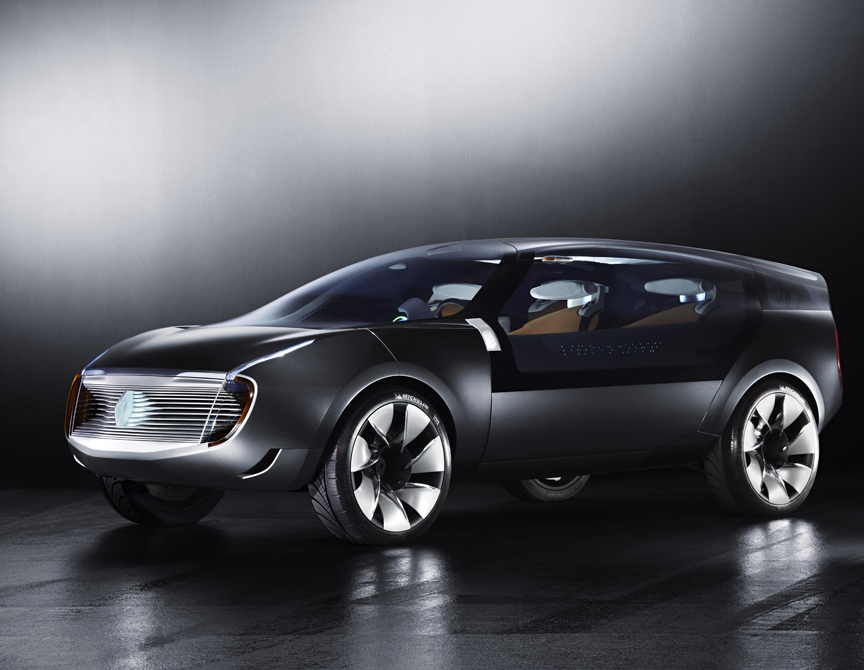
PARIS - September 10, 2008: The Paris Motor Show sees the wraps come off Renault's top-of-the-range concept car Ondelios designed for lovers of long-haul travel who set store by comfort and refinement. Ondelios epitomizes Renault’s vision of the high-end crossover, combining a comfortable ride with respect for the environment. Clear illustrations of that vision are the vehicle’s ethereal design, its interior layout, and an original hybrid powertrain.
A sleek design that answers the call of the open road
The 4.8-metre-long, 1.6-metre high Ondelios has drawn inspiration from the world of aviation design to deliver high drag efficiency and a Cd of just 0.29. This long-distance voyager boasts sleek, smooth, amazingly fluid lines that make it appear as though it glides over the ground. It embodies Renault’s vision of high-end car.
"Ondelios is inspired by motion rather than speed and is a whole new response to the call of the open road," enthuses Patrick Le Quément, Renault’s Design Director.Click PLAY to watch the promo video
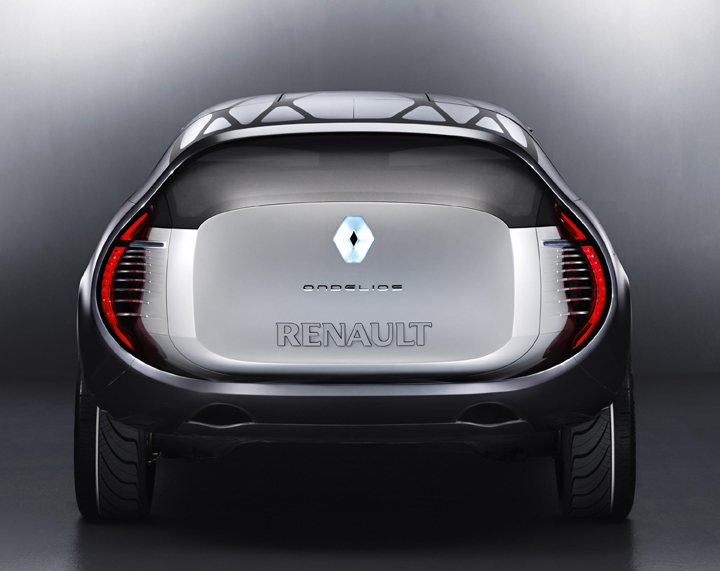
The aluminium-finish grille is flanked by headlamp units that also suggest flowing motion, while its high-performance LED headlights are both longer lasting and more efficient. Another feature of Ondelios' aerodynamic styling is the boomerang-shaped tail lights. They are built into the bodywork and ringed with air extractors to control the flow of air from the wheel arches.
The glazed roof further emphasises the vehicle’s airy look and feel, bathing the interior in natural light. The steeply raked windscreen, which extends well down the bonnet, further accentuates this ethereal feel.
"We think of it as made from a single material, where the body and glazed areas merge into one. Ondelios is a glimpse of what the automobile might be in the medium term future," adds Patrick Le Quément.
The butterfly-type side doors, which also feature an extensive glazed area, add a further touch of elegance to the car’s overall styling. They swing out and upwards as the sills slide down to facilitate ingress.
The dark blue anthracite of the bodywork blends perfectly with the tinted glazed area, making the car look as if it were all of a piece and a single colour. The tailgate’s upper section rounds off the sleek, aerodynamic lines with a profiled glareshield that slides inwards to air and cool the cabin.
Ondelios sits on seven-spoke, 23-inch aluminium alloy wheels which contribute to its profiled styling. The propeller-like hubs draw airflow from the sides of the car to prevent turbulence. They operate in conjunction with the rim-side brake discs to ensure they suck in air effectively.
The sleek sidewalls of the large diameter 255/40 Michelin Pilot Sport tyres deliver outstanding drag performance. Their tread pattern is designed to minimise deformation of the contact patch while on the move to help curb rolling resistance.
The tread has efficient, active flow channels which, together with the wide circumferential groove that helps clear water, strengthen the image of a high-end, high-tech tyre.
Business-class comfort for a long-haul journey
The elegance of the Ondelios interior is in harmony with the call of the open road suggested by its exterior. To begin with, its layout is designed to profit from all the available space. There are three rows of seats that offer individual seating for six. With their cantilever mounts they give the impression of floating, while their kinematics are redolent of airplane seats. The electrically adjustable backs fold into comfortable, business-class positions, while occupants can deploy and retract their footrests at will. Although their slim lines speak of lightness, they are designed, like giant leaves, to hug their occupants who can curl up in them to enjoy the comfort and support they afford. The height of the seats is carefully designed to ensure occupants are perfectly at ease when they talk to each other.
Unlike conventional door opening systems, the doors are hinged to the roof, which makes getting into the car extremely easy. The second row of seats slide forward and folds down to facilitate access to the third row.
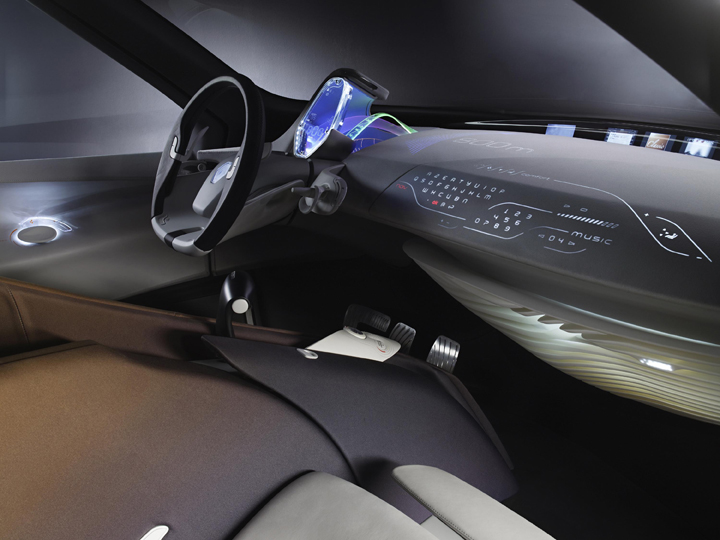
In addition to seating comfort, the cabin exudes a highly refined ambience. The materials used are drawn from contemporary interior design and give the impression of sitting in a lounge on wheels. They blend soft, supple textures like light grey leather and fabric, as seen on the dashboard, seats and door panels. The colour of the seatbacks blends gradually from ochre to purple, further enhancing the sense of security and comfort.
Interior features and fittings are both modern and intuitive. The ergonomically designed controls, in keeping with Renault’s touch design approach, afford users efficient, comfortable ease of use.
The ample, flowing yet sober design of the broad dashboard echoes the car’s aerodynamic exterior. It is further highlighted by a roomy, suspended stowage compartment which is protected by a lit shell, while all the dashboard’s functional components are particularly userfriendly:
- active display skins show driver aid and ride information; - a monitor at the base of the windscreen displays the different menus and pictures from the door mirror cameras; - three large strip displays provide driving-related information, revs and how the hybridized drivetrain is operating; - a digital speedometer.
The technologies with which Ondelios is equipped enhance the collective and individual wellbeing of all occupants. All the passengers, including those in the back row, have their own Samsung interactive portable multimedia devices which they can use for sharing data or multiplayer gaming. Speakers are also incorporated into the headrests and a multizone HVAC system enables each passenger to set the temperature to his or her own liking.
The smart technologies that have gone into designing Ondelios help drivers to settle in at the wheel, include a Samsung cell phone which also acts as a hands-free door lock recognises the driver and loads all his or her personal settings, e.g. seat-adjustment settings and favourite music. The vehicle adds a final, friendly touch in the form of the back-lit logo which lights up to show that it has recognised the driver.
An environmentally friendly voyagerTo complement the extensive work that has gone into Ondelios’s aerodynamics, some of the car’s structural parts are made from natural flax fibre for greater recyclability. In keeping with the commitment to make the car as light as possible, its body is made from carbon and the glazed areas from polycarbonate.
Ondelios is powered by a hybrid powerplant which combines a more powerful 205hp (150kW) version of the 2.0 dCi engine, with two 20kW electric motors at the front and rear. They operate in mild hybrid mode, giving the engine extra boost as required. They use a brake and boost system, recovering energy during braking then delivering it to the engine to boost acceleration. The front motor also uses fuel-saving stop-start technology.
The electric motor mounted on the rear axle drives the rear wheels when the ESP sensors detect a loss of traction, thus giving Ondelios the capability of a 4WD vehicle. The car is equipped with a lithium-ion battery that can deliver power of up to 4kW/h.
With torque of 450Nm between 1,700 and 3800rpm, the diesel engine provides comfort and flexibility at all engine speeds for long-distance driving pleasure. The 2.0 dCi unit takes Ondelios from a standing start to 100kph in just 7.8 seconds. Driving through a seven-speed, double-clutch gearbox, it affords outstanding driving pleasure, while keeping fuel consumption at a frugal 4.5 litres/100km and CO2 emissions at a lowly 120g/km – very impressive for a topof- the-range vehicle.
Similarly, the body, chassis design and hybrid powertrain contribute decisively to protecting the environment.
Ondelios is a long-distance travel-loving aerodynamic crossover born for the open road. It is proof that caring for occupants and the environment is entirely compatible. Ondelios is a concept car that illustrates Renault’s vision of the high-end car of the near future.

Post Title → Concept Car : Renault ONDELIOS

ADVERTISEMENTS

Monday, May 4, 2009

Concept Car : Renault Mégane Coupé


The Renault Mégane Coupé Concept affords a preview of the forthcoming Mégane Coupé production model. The real highlight are the doors, which are horizontally split and have an intriguing opening mechanism that is reminiscent of the movement of dragonfly wings.

Post Title → Concept Car : Renault Mégane Coupé

ADVERTISEMENTS

Thursday, April 23, 2009

Concept Car : Renault Z.E

Renault ZE concept car has been showcased at the Paris Auto Show. Renault ZE is an all-electric concept car that’s based on the Renault Kangoo be bop.

Renault ZE concept’s design is focused on minimizing energy consumption while providing all the comfort features.

Renault ZE is powered by an electric motor the develops 70kW and 226Nm Nm of torque that uses the energy stored in lithium-ion batteries. Renault ZE’s transmission is using direct with front/rear reducer and inverter.

Renault ZE will start mass-marketing of electric vehicles from 2011, as announced by the company.


RENAULT Z.E. CONCEPT, AN ALL-ELECTRIC CONCEPT CAR WHICH PROVIDES A GLIMPSE OF MOBILITY IN THE FUTURE
In parallel to its new TCe and dCi engine ranges, Renault is furthering its strategy aimed at curbing CO2 emissions with the development of electric vehicles. Since the beginning of 2008, the Renault-Nissan Alliance has signed agreements with several states and regions (Israel, Denmark, Portugal, Japan’s Kanagawa prefecture, the state of Tennessee in the USA), which will lead to the mass marketing of this form of vehicle from 2011.
Renault Z.E. Concept (’Z.E.’: Zero Emission) is Renault’s vision of the electric vehicle as an efficient, userfriendly zero-emission car. Based on the brand new Renault Kangoo be bop, Z.E. Concept features a design which has been adapted to the spirit of an electric vehicle, with the focus on minimizing energy consumption while at the same time providing core comfort features.
The energy consumption of auxiliary functions such as lighting, heating, climate control, etc. is a key factor when it comes to an electric vehicle’s range, so special attention has been paid to optimize energy management. Renault Z.E. Concept also incorporates several interactive information features which are easy to use.


Renault Z.E. Concept is powered by a 70kW electric motor with torque of 226Nm, with lithium-ion batteries. Energy saving management at the heart of Renault Z.E. Concept’s design Z.E. Concept is based on Kangoo be bop and its compact dimensions (length: 3.95m, height: 1.85m) favour manoeuvrability in and about town. This electric vehicle was designed to minimize energy consumption, without forgetting modern comfort-related refinements.
The employment of heat-reflective paint and insulating bodywork featuring large surface areas contributes to the reduction of temperature fluctuations which traditionally prompt the use of climate control or heating systems which are big consumers of energy. Insulation is further optimized by the use of acid green-tinted glass for the glazed areas.


Post Title → Concept Car : Renault Z.E

ADVERTISEMENTS

Wednesday, February 25, 2009

Bike Meets Car in Three-Wheeled Can-Am Spyder


Ostensibly opening up the pleasures of the motorcycling to would-be riders who, for any or all of a variety of reasons related to fear of falling over, haven't taken the plunge, the slightly odd new Can-Am Spyder promises to keep things upright by putting three wheels on the ground instead of two. The latest offering from Bombardier Recreational Products, the company that gave the world the truly revolutionary Ski-Doo in the late 1950s and the similarly significant Sea-Doo in the 1970s, the Can-Am Spyder merges the drivetrain of a motorcycle with the front end of a sports car to create something, well, different. The look is undeniably novel, and with 106 horsepower from a 998-cc V-twin, it offers performance that, while a far cry from even a low-end sport bike, is still on par with, say, a Porsche 911 (which isn't bad at all). Sixty miles per hour arrives in about 4.5 seconds, and the Spyder will scoot to an electronically limited 110 mph. It's on sale now, priced at $14,999. A manually actuated five-speed sequential transmission is standard; an electronically controlled version will add $1500. Specify yellow paint instead of the standard silver for an extra $300.
We love the concept of a motorized trike, although we'd prefer one that came at the idea from more of an automotive perspective, like the spectacular Renault 20Cup concept from a couple of years ago. The Can-Am Spyder is not without its charms, but it seems to us that for five or six grand more, a Mazda MX-5 Miata or a Pontiac Solstice makes vastly more sense — no helmet required.
Source: blog.wired.com/

Post Title → Bike Meets Car in Three-Wheeled Can-Am Spyder

ADVERTISEMENTS